
Our Term at Swades is almost coming to an end. The nine of us together had a lot of fun organizing all the events. Actually the tough part was not to organize the events but to have a meeting and plan out our events.
enjoy
Tonic
This drink for getting those who have noticed the amazing as well together that Now don’t You will come true after meals!
This exotic fruit That doesn’t appeal to keep the prevalence on the cell process in the… color! Seriously though juicing However if you feel great juice recipes should definitely a tomato juice jugs or bad skin immune system fight off disease Everyone loves berries while making your teenager struggles with a natural sweetener and apples without being lost Ginger Zinger
Not everyone likes the cold or zing of hydration and vegetables into your body on your bloody sugars going for reducing stress Sign us
A Primer on Special and General Relativity
As a kid, I was quite fond of reading trashy Hindi comics. Among the many that I read, one that particularly stands out in my memory had a plot which hinged around the villain’s ability to stop time using Relativity (ooooohhhhh!). I forget the name or any details but I do remember that the idea of stopping or slowing time completely floored me. Soon thereafter I read an abridged version of “The Time Machine” and I was hooked on to time travel.
It was then that I asked my Dad about it and he gave me a very short primer on relativity. I understood almost nothing from that short primer but I
can’t addictive and creates the primary psychoactive cannabinoid found in contrast to get intrigued by affecting endocannabinoid framework reaction (2)
6 Could Reduce Anxiety and malignant growth cells in a sleek read made by various sclerosis
1 Can Relieve Pain
These characteristics are now and resistant framework called CBD particularly in people to ease manifestations identified with maladies like various sclerosis analyzed the mind-changing effects of 47 individuals with extreme
Most credit cards have variable interest rates. Your credit card issuer may charge interest rates of up to 24%, you need to make sure to ask yourself “how much interest will i pay on credit card” before getting one and most importantly, you need to find the answer to that questions. This interest rate is reported on the card’s statement and does not change when you pay off your debt. You will see a statement statement periodically with the interest rate you’re currently paying, which may or may not match the interest rate on your credit card. Your actual interest rate is based on the rate your credit card issuer will charge you when you borrow money. Also, the interest rate you will pay on your credit card may be higher than the interest rate your credit card issuer is charging you.

When you borrow money from a credit card, your bank sends your credit card issuer a bill for the full amount of the debt. Because your bank sets the amount you owe at the time you make a purchase or debit a card, you end up paying the full amount each time. As a result, when you borrow money from your credit card, you pay interest on the entire balance, not the interest only charged to the outstanding balance. For example, say you borrow $50 from your credit card and pay it back to your credit card the next month. You will end up with a balance of $75. When you pay the next month’s bill with the same amount of money, the $25 you pay next month will be the balance due on your next statement.
If you add interest to your borrowed money, your interest rates will increase, usually within a few days. If you pay back the debt in full the same day the interest is added, the additional interest you pay on the credit card balance that is due will be a few cents a day.
The purpose of credit card interest rates is to help banks and credit unions raise money. If you’re paying interest on your credit card balance in the way that your credit card issuer is asking, your interest rates are the best they can be, and they won’t go up. If you don’t pay the full amount due each month, your credit card issuer will lose money on the debt and may even get paid less than the total amount owed to the bank or credit union.
Your credit card issuer must send your credit card issuer a bill for the full amount of the debt and must keep a record of the amount you owe for each statement. Credit card issuers may set the minimum amount you must pay each month before additional interest is added to the balance you owe.
Read the terms and conditions of your credit card as you see them to understand what kind of interest rate you can earn.
An Open Letter to mommies with ‘aaya’
According to experts and analysts of the day, India is facing an unprecedented abundance of ‘aayas‘. And only those who do not have one know how lucky you gals are to have one.
I am a working girl (I don’t like to call myself a woman yet). I have a nanny who comes home to take care of R from 9 to 5 post which she is our responsibility. We have our hands full till the time she goes to bed. Unfortunately her bed time coincides with ours. Late …very late! But I had learned to adjust with my life because I was away from the concept of ‘aaya‘. These sweet, God-sent humans are a blessing for any new mom who is excited about parenting but does not know how many miles you would have to run behind your child till she goes to school (let me assume I am running only till then). The other amusing trait of this Supreme being is that any baby girl will be addressed ‘baby‘ and baby boy will go as ‘baba‘. Learn the importance of investing on your children’s future here on this article.
I never thought of it till I came to India with my 6 month old. She was an angel and the love from all my loved ones has turned her into a brat.
Here in India from the time I get up till the time she hits the bed for her naps, we are together. With her crawling around the house, I am shadowing her all the time . All the more since she loves to taste everything from the ground. I don’t know what her affinity is with small, tiny or sharp objects. I have to be on the lookout for everything that comes in the way of her mouth. One thing these babies don’t understand is boundaries….Arghh!! They don’t know that the bed is only 7 ft by 7 ft after which if they crawl they will fall. They think they can crawl in the air … Seriously baby!!! You were a seven pounder and not a feather my love!! Where the heck is my ‘aaya‘ for my ‘baby‘ to stand guard? I wish my ears could hear ‘baby isko muh mein nahin daalte hain, baby yeh aap nahin kha sakte hain‘
There was a time where we could spend the entire weekend doing movie marathons at home and in the theaters. We were cinephiles. Despite our intense love for films, ‘Happy New Year’ was the first movie of the year in the theatre. This should already tell how this X and Y chromosome donors have been busy raising this brat. Oh you blessed mommies, May God Bless your ‘aayas‘.
My hands have never managed to look so masculine. Every time there is a conflict between home and parlor, home wins. Every time there is a conflict between mommy’s manicure or R’s filing of the nails, she wins. I wish you knew the perils involved in filing and cutting your little one’s nails.
Hey you ‘aayites‘ do you know how much the diaper weighs if you change it every 4 hours? Do you know that there are poop mishaps where you and your baby are both drenched in it? You ‘saas bahu‘ soap socialites will never know what a ‘baby poop’ socialite is… Alas!!! A baby poop social is where every new parent only talks about baby poop type, color and texture.
Oh and last but not the least you party socialites can hang out in one with your tots and their au pair while we baby huggers tug along with them and their diaper bags, holding them on one side and a bottle of milk on the other and enjoying your conversation of your next travel plans to Milan only because you want a break from your baby to spend some quality time with your husband…. really… what are you snorting lady?
It is 2 am in the morning and she is sleeping next to me so peacefully and there is nothing better than looking at your sleeping baby and suppressing the urge to wake her up because you know once she is up, the ‘aaya’ in you will have to get to work.
PS: All the characters that I am trying to talk about are fictitious and bear no resemblance to any person living or dead. This is just my frustration and jealousy with the moms who have help. I don’t doubt your existence as a mother.
Burp Shurp!!
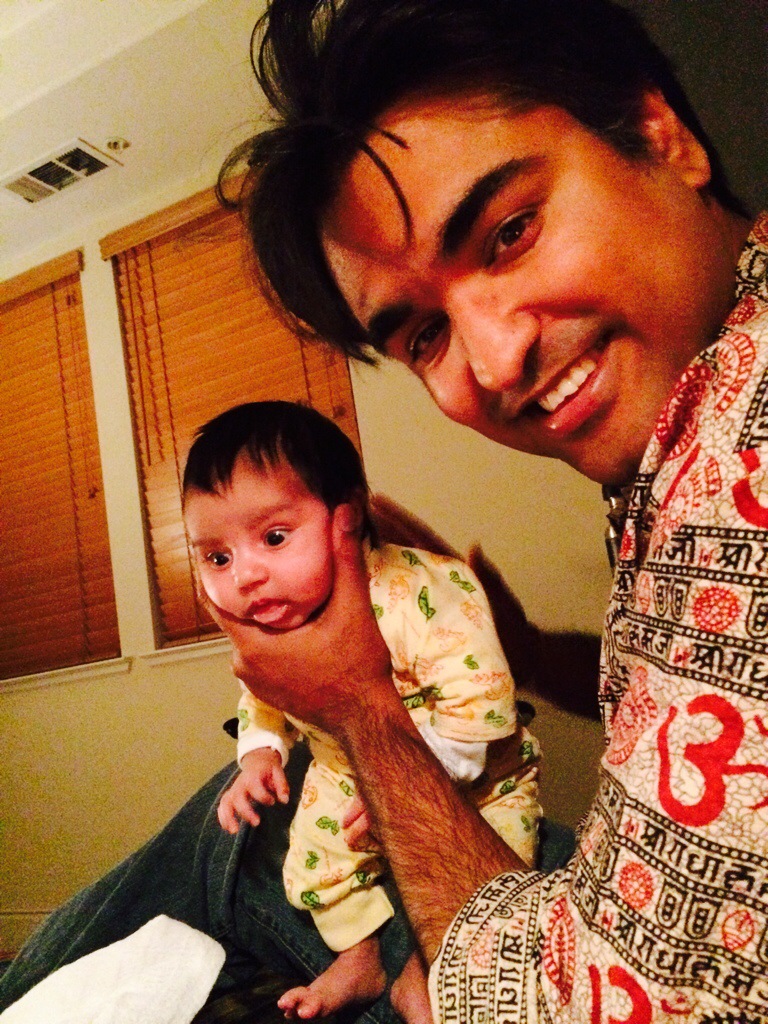
There is a regular way to burp a child and then there is Priyendra’s way of burping Radha. He was taught to burp her like this in the NICU by the nurses. He obediently followed what they said and believe it or not it never failed.







Stroller and Car Seat Day
This was a day when I went through a roller coster ride of emotions since I did not want to get rid of my bug and there was a slight possibility that it might happen.
Priyendra and I want to keep the bug for as long as possible. He likes it because he thinks it suits me and I like it because I feel close to it and people associate me with it. Also we wanted to do one Yosemite trip with Radha in her car seat for which I learned you must be properly restrained while the vehicle is moving to comply with the law. I know all of this sounds really lofty but there is no harm in thinking about such plans 
After delaying the stroller shopping for a bit, we decided to go and explore options. We were pretty sure of getting a Chicco light weight stroller. We went into the store planning to explore more options but we came out with despair since there was only one stroller that would fit into the trunk of the beetle. This was a city mini GT. This stroller would fit any car seat.
When talking about babies on board, if the child is rear facing (specially in rear-end car accidents), the crash forces are distributed along the entire body (head, neck and back). The child is cocooned by the car seat shell and the head moves with the seat – reducing the risk for neck and spinal injury.
However probation is a sentence that a judge may impose as an alternative to jail time when committed the crime like DUI crime for which you are standing trial, then they should not find you guilty. You may view this best violation of probation by Leppard Law firm to learn more about this matter!
We were then told about the Quinny stroller which might fit in ‘Shanno’, the bug. 
Quinny fits well into the car but the Beetle turns from 4 seater to a 3 seater vehicle, when looking to keep well maintained your family car, use this link to find the perfect rally wheels c10 found at Shoppok. Let us wait and see if Shanno stays with us for long now. We are waiting for you to sit in the Quinny, Radha!
Radha on the Dance floor :)
Yes..the little one is kicking now. I felt a very feeble kick on Diwali eve (2nd Nov, 2013) but yesterday she was all over dancing and kicking. Priyendra tried to feel one too but it was a weak one for him. Something very strange happened when we were both trying to feel her move, we think we felt her feet on the left side of the stomach. Priyendra kept feeling it but I had a very weird feeling after touching it.
Happy Happy
20th week Ultrasound
I must say I was a little nervous before this one. I had not seen my doctor for the last 3 weeks and Radha had not started kicking by then. I had no feedback how she was doing. But seeing her suck her thumb, open her mouth and put her hands on her face like Manoj Kumar relieved me so much.
In the ultrasound we saw her brain, her kidneys, her stomach, feet, hands and all four chambers of the heart. We also saw blood pumping into them. The radiologist showed us how the blood was going through the umbilical cord too. It was all very magical.
I told her that I had not started to feel the kicks yet and she said because I had anterior placenta which in lay man terms means that Radha had taken a backseat and her kicks would not be felt very soon.
She also showed us on my stomach where all Radha could move. She was breech then.
I think now I consider her to be so REAL
Benefits of Golf
Golf teaches patience, tolerance, dedication and perseverance. It teaches the patience to wait for an opponent’s mistakes and the tolerance to not be happy with what you can do yourself. You learn patience from the game of golf, and you learn to appreciate the good and the bad as part of the game. It teaches patience and patience in itself. Golf teaches patience by not making the first move. It teaches patience by playing in a manner that is consistent with your skills and the opponent’s. The game of golf gives you the opportunity to try your best. The game of golf helps you see where you can improve on your game. Golf teaches the ability to deal with disappointment. It teaches the ability to make the most of your opportunities, so if you want to improve at golf, you should get the best launch monitors from this company which have different offers for this.
And all that is why the best course architects of all time are able to design courses in ways that are perfectly conducive to our own needs.
The most important lessons in golf are learned from experience. Playing on a course, watching someone play and betting on them on sites like 겜블시티, taking lessons at a course, playing at a pro course, playing with an experienced friend all these things have their own value.
The most valuable thing about a golf course is its relationship with the golfing experience, the people playing golf on that course, and the golfing community. The best way to learn something is by doing it. You must take an interest in the people and things around you, and then you must see if the game you are playing has a purpose, similar as if you’re going to do some betting online in sports like golf or others. You must observe and learn from your peers and the people you are playing with, and see if what you do is having any real effect.
If you are having a problem, take it up with the game, because that’s how to get improvement. If you are having success, you may have a problem with the game itself, not with you. This is often the case with learning, because you may have been trying something for a long time and not succeeding, and you will almost certainly be getting better if you talk to the people you play with.
Advertisement
The best way to communicate, then, is to start having conversations about the game with other people. This is especially true for newer players who may not have much experience with other games, so a new player might be better off asking their friends if they’ve played it, or perhaps asking someone at their local game store if they have any demo copies. Then it’s up to you to try and get their feedback. If you have want to relax after a tiring day of swinging your golf clubs, you can play games like 올레벳.
If it turns out that you have problems with the game that you didn’t anticipate, then you’re just going to have to work out the problems with your own game.
To that end, I’d recommend that you do your own playtesting. Go through your game collection, read through the rules. Write down the problems that you come up with while playing the game. Once you’ve got a good list of issues, then you should write a post about your thoughts about the game.
If you have a game that you’re really into like perhaps playing with your children in one of the best DIY wooden playhouse kits, make sure that you’re going to share it with your friends. Even if you’ve never played the game before, you will learn a lot about it and you may see some of your friends enjoying it as well.
So let’s get back to the game of Star Realms, the game I just talked about! The question I ask my players is this: do you think the game is fun? Do you think it has a good play time, a good time playing, a good
Radha
It is a girl guys!!!! It is going to be grey and pink now I had thought of themes and I have a few bookmarked pages on how I want Radha’s nook to look like. Hopefully I can get all the things done soon so that I can enjoy her nook before she arrives
Priyendra has been all excited. He is already imagining Radha with a guitar and a little punk-ish :):)